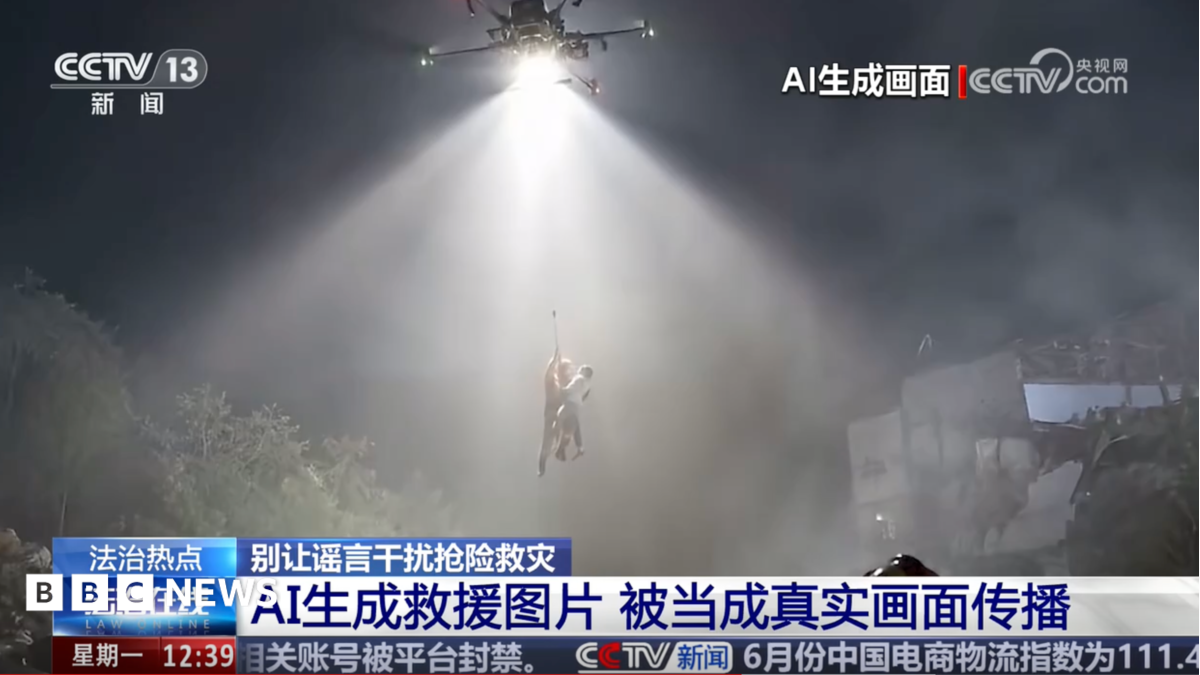
And this is not an unusual occurrence.
In 2021, local officials were arrested, accused of concealing or underreporting the deaths of 139 people in Henan province.
Events like these have led to a trust vacuum that has made it easier for bad actors to spread fake content.
But police are urging people to trust authorized sources during emergencies.
“If you come across disaster-related information from an unknown source, approach it with skepticism and rely on official announcements,” said Gao Kai of the Ningbo Public Security Bureau.
He also tried to assure the public that the creators of false information will be caught, saying “the internet is not a lawless place. Public security authorities will continue to strengthen efforts to eradicate illegal online activity”.
“We have created a special team that will carefully monitor social media platforms, especially short video platforms. They will investigate and deal with these cases immediately, and disperse them in a strict manner”.
Punishment can range from a fine to up to seven years in prison if the falsification is serious enough.
On July 23, China’s Cyberspace Administration also announced a nationwide crackdown on fake Internet content related to floods and other disasters, ordering its local branches to focus on finding fabricated data, malicious programming, staged scenes, unmentioned historical events and those officials impersonating themselves. In addition, it asked social media to strengthen the review of the content they publish.
Prof Gao believes that “the answer is public education combined with law enforcement”, saying that “there is a need to publicize real crimes where people are punished.”
He added that “harm caused by fake content generated by AI is ultimately a result of how people choose to use the technology – not the technology itself”, adding that existing laws were sufficient to deal with it.
However, others are not so confident. Professor Chen pointed out that “AI technology continues to evolve faster than legal frameworks. As new legal questions emerge, AI misinformation remains a major challenge.”
Shanghai and Washington-based lawyer Peter Pang says lawyers around the world are seeing an explosion in the number of cases dealing with these issues.
He believes that companies that create AI applications and platforms that are used to publish fake videos and other material should be held accountable along with the people who create misinformation.
“The first line will be the platforms, because they are the ones that allow this to come out,” he told the BBC.
He used the hypothetical example of a person running over a pedestrian following a panic caused by a fake post on social media.
“The creator of the video might say ‘you beat someone. That’s your problem. I didn’t do it.’ But let’s think about it. He created a foundation that people responded to. If you created that fear, you need to be responsible for the consequences.”
And Professor Xu warns that “false information generated by AI is likely to increase not only in volume but also in the speed at which it spreads.”
“Looking forward, political elections, public health emergencies, conflicts, natural disasters and public health issues are all likely to be areas of greatest vulnerability to AI-generated disinformation.
“Instead of waiting for disinformation to spread before trying to contain it, governments and platforms should now prepare in advance.”