Trump tells Congress ‘hostility’ with Iran is ‘over’ as conflict reaches 60-day deadline

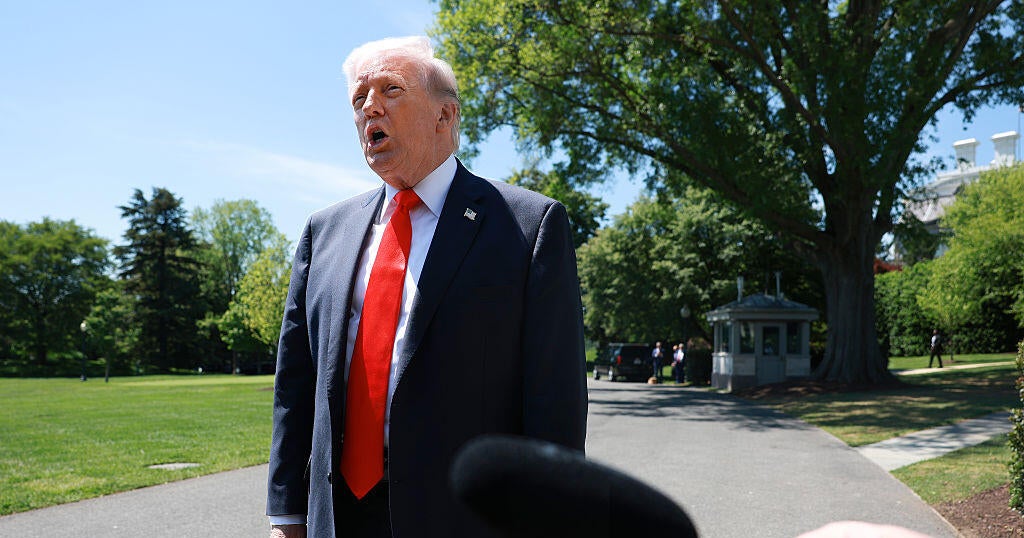
Washington – President Trump on Friday told congressional leaders that the “hostility” with Iran is “over,” referring to Iran critical deadline of 60 days under a law aimed at reducing the unauthorized use of military force.
“There has been no exchange of fire between United States Forces and Iran since April 7, 2026,” the president wrote in nearly identical letters to House Speaker Mike Johnson and Sen. Chuck Grassley, president of the Senate. “The conflicts that started on February 28, 2026 are over.”
The framers of the Constitution gave Congress the power to declare war. Nearly two and a half centuries later, that authority is again in the middle of a political and constitutional storm.
At issue is the 1973 War Powers Resolution, a post-Vietnam law aimed at curbing presidential authority and ensuring that long-term military engagements receive congressional approval. But as the war with Iran enters a critical phase, the limits of the law – and its ambiguity – are being tested in real time.
The conflict began on Feb. 28, when US forces, along with Israel, launched large-scale strikes on Iranian targets, triggering a wide-ranging regional conflict. In recent weeks, Iran has retaliated, energy markets around the world have been disrupted and the Republican-controlled Congress has been reluctant to express its constitutional role.
Under the War Powers Resolution, the president may start a war without prior authorization but must notify Congress within 48 hours and end hostilities within 60 days unless lawmakers approve an extension. That 60-day clock, set in motion by the president’s notice to lawmakers on March 2, reached its deadline on Friday — a moment that has intensified tensions in Washington.
A growing number of Republican lawmakers said the administration should begin ending the Iran campaign. Others say they are working on legislation authorizing the administration to use force against Iran, which would bypass the War Powers Resolution debate.
The Trump administration has argued that the ceasefire imposed in early April ended active hostilities, therefore stopping the official count.
Defense Secretary Pete Hegseth on Thursday said the ceasefire had delayed a 60-day deadline for congressional approval.
“We’re on the road to a cease-fire right now, which our understanding is that the 60-day clock stops or stops when there is a cease-fire,” Hegseth said during testimony before the Senate Armed Services Committee.
That argument, which the president made clear in his message to Congress, did not move other lawmakers.
“I don’t believe this legislation can support that,” said Democratic Sen. Tim Kaine of Virginia, adding that Friday’s 60-day deadline “will pose a really important legal question to the administration.”
“We have serious constitutional concerns, and we don’t want to impose on those who have additional legal problems,” Kaine said.
Despite the cease-fire, the administration has imposed a blockade of shipping in Iranian ports, which is considered an act of war, and the US has threatened to resume strikes. Just days after the ceasefire was announced, Hegseth said soldiers could return to work “at the push of a button.”
“We’re locked out and overwhelmed by your critical dual-use infrastructure, your remaining power generation and your power plant,” Hegseth said during a briefing at the Pentagon. “It is better not to do it, but we are ready to go at the command of our president and at the push of a button.”
The US still has more than 50,000 service members in the Middle East. The President said in his letter on Friday that those forces are still in danger.
“Despite the success of the United States’ operations against the Iranian regime and ongoing efforts to achieve a lasting peace, the threat posed by Iran to the United States and its Armed Forces remains significant,” he said. “Therefore, the Department of Defense continues to renew its forces in the area [area of operations] in selected countries, as necessary and appropriate, to address threats from Iranian and Iranian proxy forces and to protect the United States and its allies and partners. “
Congress has never successfully used the War Powers Resolution to end a military campaign, and there are examples of previous administrations interpreting the resolution in a way that allowed military operations to continue.
“Let me just tell you, in the power of war, many presidents, as you know, have passed,” said Mr. Trump told reporters at the White House on Friday. “It’s never been implemented. It’s never been enforced. And every other president considers it unconstitutional. And we agree with that.”
In 2011, the Obama administration argued that it did not require congressional authorization for airstrikes against Libya to exceed 60 days because the operation did not rise to the level of “hostility.”
During the military strikes in Somalia in 1993, President Bill Clinton’s administration argued that it did not need congressional authorization because the conflict “did not continue.” During Clinton’s second term, the administration continued its bombing campaign in Kosovo for a 60-day time limit, saying lawmakers had authorized the operation by approving its funding.
Mr. Trump voted for a resolution that sought to end US military involvement in Yemen after it passed both chambers with bipartisan support in 2019. Congress did not have the votes to override the veto.