Protests in Italy: Dozens injured in Bologna after a man died after being stopped by the police

There have been protests in Italy after the death of a man born in Morocco when he was forcibly stopped by two policemen in the northern city of Bologna.
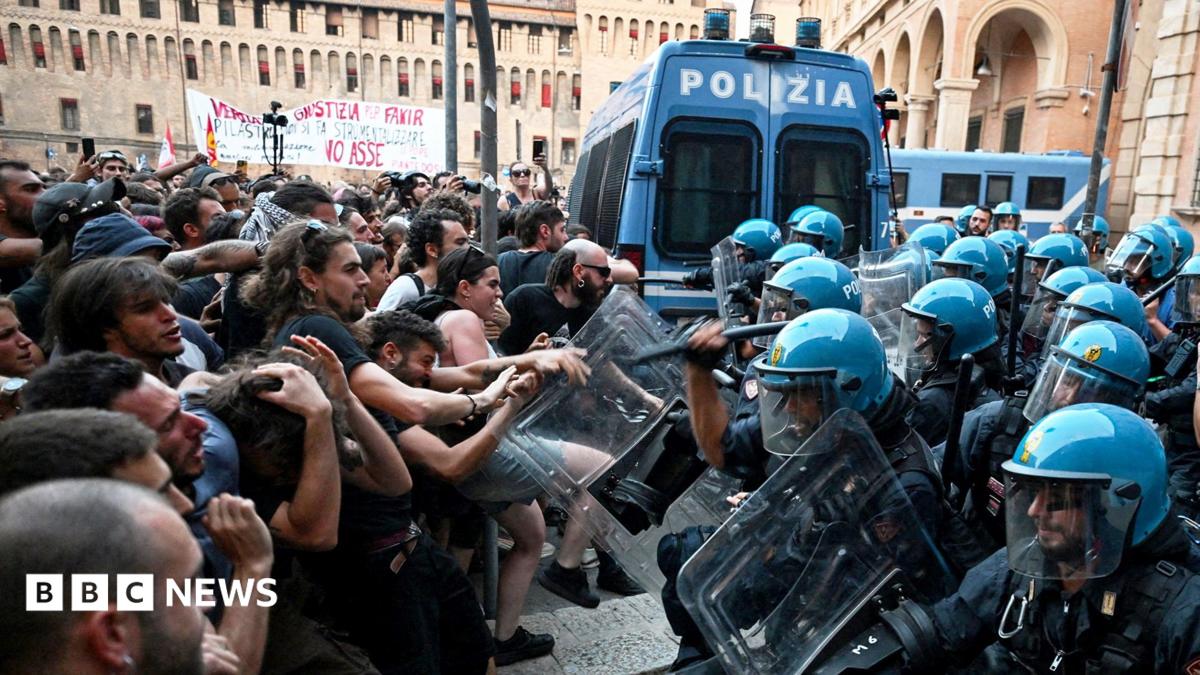
Several thousand people took to the streets on Monday night demanding “justice for Abderrahim Fakir”.
The small group then separated and clashed with the police until nightfall. Prosecutors say 64 police officers were injured in the riot.
Prime Minister Giorgia Meloni said it is important to investigate the truth about his death but “nothing can justify violence against law enforcement”.
Police were called on Sunday morning after a neighbor saw Fakir “behaving erratically” and kicking garage doors in the Pilastro neighborhood. The police tried to calm the situation but then they used pepper spray.
A video circulating in the Italian media shows two policemen sitting on Fakir as he lay face down crying for him to stop. A third person, who is not a police officer, has his legs pinned to the ground as paramedics stand by.
About two minutes into the video, Fakir stops struggling. The police tied his wrists and ankles and, when one of them saw that Fakir was not moving, hit him twice on the cheek. When an ambulance worker arrived, it was clear that Fakir was unconscious.
Prosecutors in Bologna have opened an investigation into the murder of the police and medical personnel who were present at the scene.
Several eyewitnesses told Italian media that although Fakir appeared distressed, he did not threaten anyone and was unarmed.
“You will not die like this,” said his sister Khadija telling Italian media. “They killed him mercilessly, I want the truth.”
Bologna Mayor Matteo Lepore told Italian newspaper La Repubblica that anyone who saw the video was “shocked”.
He called for a demonstration in central Bologna on Monday evening and invited Fakir’s nephew to join him on stage.
“He was my uncle. He wasn’t a number, he wasn’t a story line… he was loved,” Yossra Fakir said. “He deserved to be helped and heard, he deserved dignity.”
Although the main protest on Monday night was peaceful, about 100 protesters clashed with the police at night and burned two cars.
Lepore said on Tuesday that he saw “two different squares” in Bologna – “thousands of people gathered peacefully and spontaneously to express their support for the family of Abderrahim Fakir” and a small group that “thinks they can respond to violence with violence”.
Domenico Pianese, Secretary-General of the police union, criticized Lepore’s decision to call the protest which ended in chaos.
Calling for a protest “the day after an incredible event like this,” said Pianese, is like calling “all anarchists and those who are against the police… to take advantage and protest against the state”.
When asked what the police did wrong when they detained Fakir, he said: “If we look at the pictures we have seen, the intervention was done properly.
Pianese said the fact that the two police officers had to use pepper spray and needed the help of a layman to arrest Fakir shows that the use of force was not excessive. “The first thing they did [after the incident] it was… the whole hand [bodycam] pictures of prosecutors,” he said.