Trump administration pays wind developer to walk away from California offshore lease

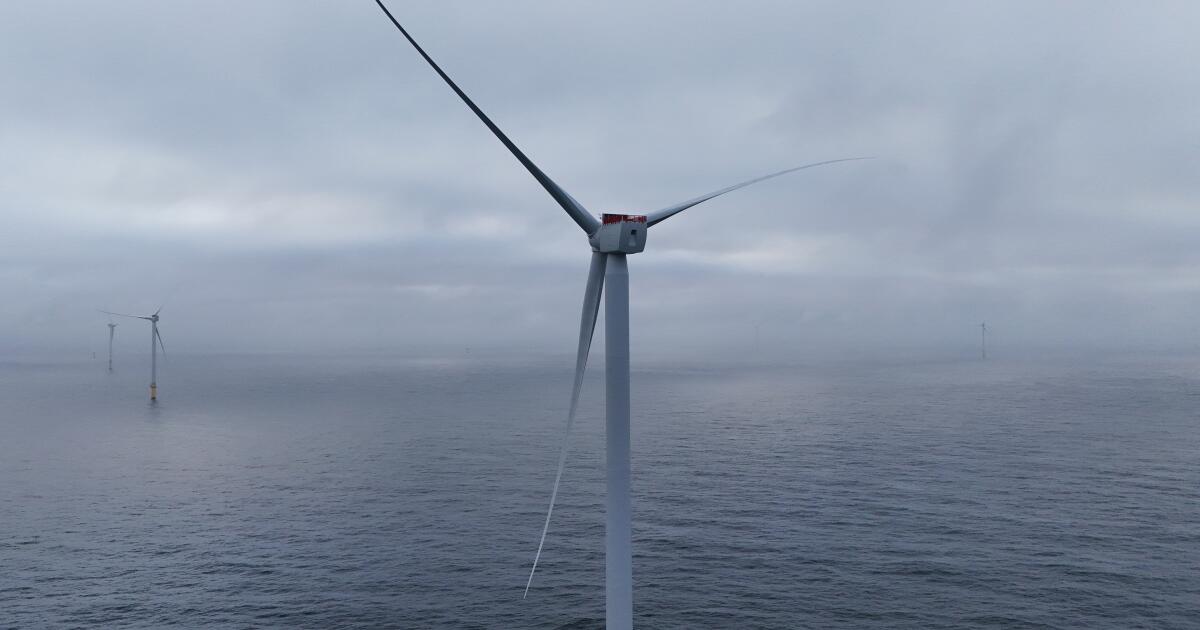
The Trump administration on Monday said it would pay two other energy companies, including one developing a wind project in Morro Bay, to leave their projects in federal waters.
The US Department of the Interior said it would pay a total of $885 million to Bluepoint Wind and Golden State Wind to voluntarily end their offshore wind leases, with both agreeing to invest instead in “reliable conventional projects.”
The move follows a similar $1-billion deal with French company TotalEnergies – which agreed in March to withdraw from offshore wind leases off the coast of North Carolina and New York – and is yet another escalation of President Trump’s efforts to block clean energy projects in favor of oil, gas and coal.
Golden State Wind was one of five California offshore wind leases near Morro Bay. Under the deal, the company will be eligible to return up to $120 million in lease payments after it invests an equal amount to develop US oil and gas assets, energy infrastructure or liquefied natural gas projects along the Gulf Coast, the Interior Department said.
The California project was expected to generate up to 2 gigawatts of clean offshore wind power, or enough to power about 1.1 million homes, according to the company, which is a joint venture between developers Ocean Winds and Reventus Power.
“We welcome the opportunity to engage constructively with management regarding this agreement and appreciate the clarity they have provided regarding this decision and the agreement,” read a statement from Michael Brand, CEO of Ocean Winds North America. “Our priority remains allocating capital efficiently and delivering reliable energy solutions that create long-term value for ratepayers, partners and shareholders.”
New Jersey’s Bluepoint Wind is a partnership between Ocean Winds and Global Infrastructure Partners, part of BlackRock. Its project was a 2.4 gigawatt wind farm in early development off the coast of New Jersey and New York.
In its place, the company has committed to investing up to $765 million in US liquefied natural gas, the amount of its first wind energy bid under the Biden administration. The government will reimburse the company the full amount of its investment upon completion.
Both companies “have decided not to pursue any new offshore wind developments in the United States,” the Interior Department said.
President Trump has been notoriously vocal about offshore wind, including canceling federal funding and ordering a halt to projects nearing completion on the East Coast. Last year, his administration cut nearly half a billion dollars to support offshore wind development in Northern California’s Humboldt Bay.
Interior Secretary Doug Burgum, who has also been critical of offshore wind, said Monday that the industry was “subsidized by massive taxpayer subsidies” as companies bid for leases through 2022.
“Now that hard-working Americans are no longer footing the bill for expensive, unreliable, slow-moving energy projects, companies are reinvesting in cost-effective, reliable and secure energy infrastructure,” Burgum said.
Others, including Democratic lawmakers, have questioned whether it is legal to pay companies to leave and their use of taxpayer dollars. In an April 6 letter to the Department of the Interior and the Department of Justice, California attorney Jared Huffman and Maryland attorney Jamie Raskin described the $1-billion deal with TotalEnergies as “egregious” and “virtually illegal.”
“There is no clear legal basis for this closed-door settlement, which allows the administration to fund their preferred energy sources regardless of what is best for the American people,” the lawmakers wrote. “President Trump has been relentless in his attacks on affordable, clean energy. This back-to-back deal to cancel these projects will inevitably have negative economic, environmental, and national security impacts that must be addressed.”
It was not immediately clear what Monday’s agreement would mean for California’s offshore wind targets, which include 25 gigawatts of offshore wind power by 2045. Four leases, including two for Humboldt Bay and two for Morro Bay, are still up for grabs.